April 12, 2026 / Nirav Shah
The web development landscape in the United Kingdom is evolving faster than at any point in the past decade. Driven by advances in artificial intelligence, the maturation of cloud infrastructure, rising user expectations, and the competitive pressure of a digital-first economy, UK businesses that fail to keep pace with web development trends risk falling behind their competitors — and losing customers to more digitally capable rivals.
At Eternal Web Private Limited, we work with businesses across the UK every day to design, build, and optimise web applications that perform at the leading edge of what is technically possible. In this article, we outline the top web development trends UK businesses need to understand and act on in 2026 — and explain how each one creates real opportunity for growth.
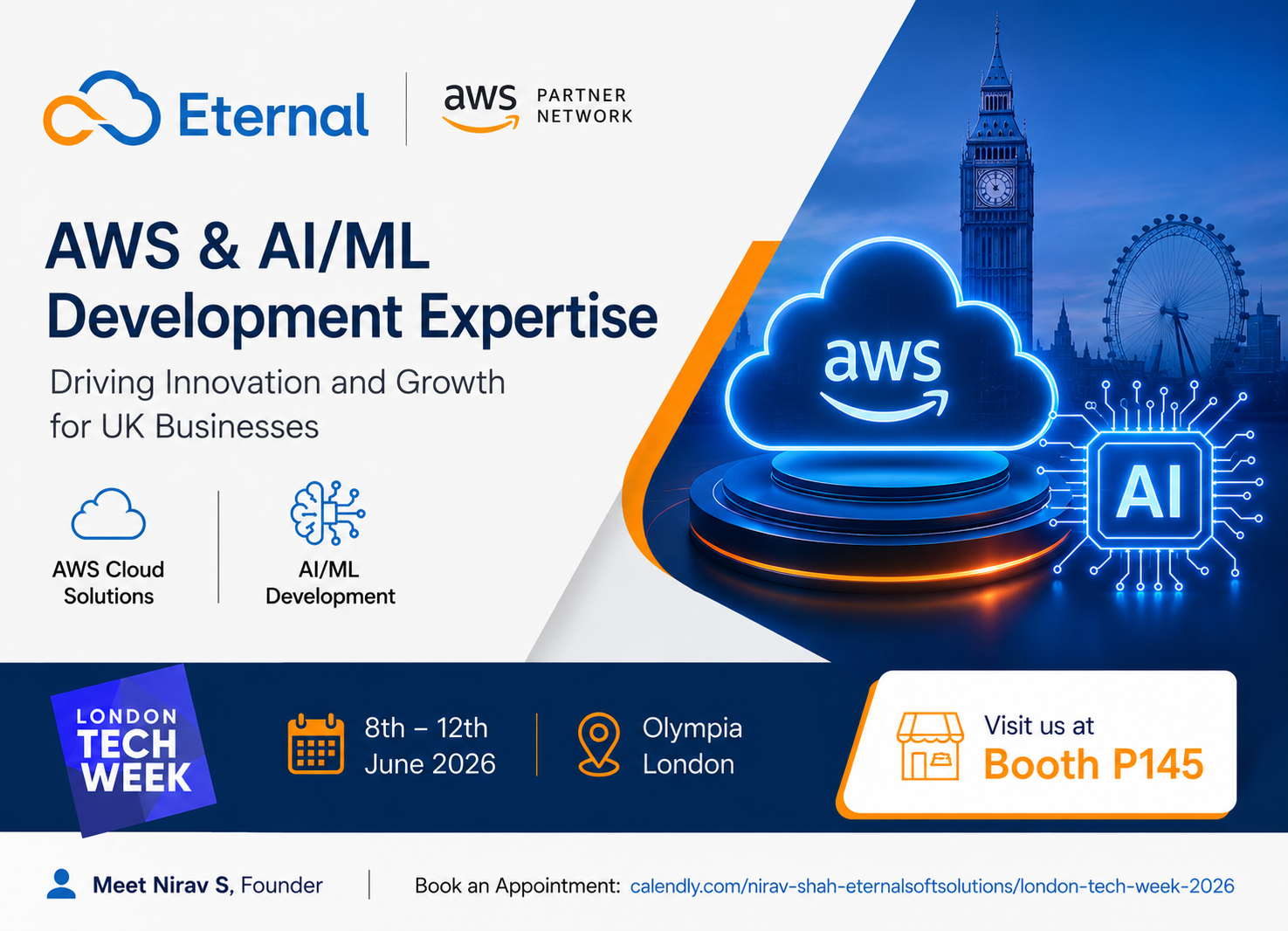
We will also be showcasing many of these capabilities in person at London Tech Week 2026 at Olympia London from 9–13 June. If you want to see these trends demonstrated in live, production systems, come and visit our stand.
In 2024 and 2025, AI integration in web applications was a differentiator. In 2026, it is a baseline expectation. UK businesses that have not yet integrated AI into their customer-facing web applications are already behind their most competitive peers — and the gap is widening.
The most impactful AI integrations in web development today include conversational AI and intelligent chatbots that handle genuine customer service workloads, AI-powered search that understands intent rather than just matching keywords, personalisation engines that adapt content and product recommendations in real time, intelligent form completion and lead qualification, and AI-generated content that maintains brand voice while dramatically reducing production costs.
For UK businesses, the question in 2026 is not whether to integrate AI but which AI capability to build first and how to integrate it cleanly into an existing website or application without disrupting the user experience. Eternal Web specialises in exactly this challenge — identifying the highest-value AI integration for your specific business context and building it in a way that is reliable, scalable, and maintainable.
Traditional monolithic web platforms — where your content management system, front end, and back end are tightly coupled — are increasingly being replaced by composable architectures that give development teams far greater flexibility and performance.
A headless CMS separates the content layer from the presentation layer, allowing content to be delivered to any channel — website, mobile app, digital signage, voice interface — via API. This approach enables dramatically faster page loads, better developer experience, and the ability to swap out individual components of the technology stack without rebuilding everything.
For UK businesses with complex content requirements, multiple digital touchpoints, or ambitious plans for future growth, headless architecture is worth serious consideration in 2026. The performance and flexibility gains are substantial, and the tooling has matured to the point where the implementation complexity is now manageable for most business contexts.
Google’s Core Web Vitals — the set of user experience metrics that measure loading speed, interactivity, and visual stability — continue to be a direct ranking factor in 2026. UK businesses with slow, poorly optimised websites are not just frustrating their users; they are actively being penalised in search rankings relative to faster competitors.
The key performance metrics that matter most are Largest Contentful Paint (LCP), measuring how fast the main content loads; Interaction to Next Paint (INP), measuring how responsive the page is to user input; and Cumulative Layout Shift (CLS), measuring visual stability as elements load. A performance-first development approach — where speed and responsiveness are built in from the start rather than optimised as an afterthought — is now essential for any web development project that expects to compete organically.
Eternal Web builds performance-first from day one. Every web application we deliver is benchmarked against Core Web Vitals during development, not as a post-launch optimisation exercise.
For many UK businesses that previously considered building a native iOS or Android app, Progressive Web Apps now offer a compelling alternative. A PWA is a web application that behaves like a native app — it can be installed on a user’s home screen, works offline, sends push notifications, and loads near-instantly — but is built with standard web technologies and deployed through a web browser rather than an app store.
The advantages for UK businesses are significant: a single codebase works across all platforms, there is no app store approval process, updates deploy instantly, and the development cost is substantially lower than building separate native apps. For businesses in retail, professional services, hospitality, and healthcare, PWAs are delivering the app-like experience users expect at a fraction of the traditional cost.
Modern UK businesses operate with a growing ecosystem of software tools — CRM, ERP, marketing automation, payment systems, logistics platforms, HR software — and their websites and web applications need to integrate cleanly with all of them. API-first development — where integration capability is designed into the architecture from the beginning rather than bolted on later — is now the standard approach for any web project that will need to connect with third-party systems.
In 2026, the volume and complexity of integrations UK businesses need is continuing to grow. AI services, payment platforms, identity providers, analytics tools, and business intelligence systems all require robust, well-designed API integrations to function reliably. Businesses that invest in clean API architecture early avoid the expensive rework that results from poor integration design — a problem we see frequently when clients come to us to fix or replace systems built without this approach.
Web accessibility — ensuring that websites and web applications are usable by people with disabilities — is both a legal requirement and a commercial opportunity for UK businesses. The Equality Act 2010 applies to websites, and with an estimated 16 million disabled people in the UK, accessibility is also good business.
In 2026, accessibility standards are tightening across the EU and UK, with the European Accessibility Act bringing stricter compliance requirements into force. WCAG 2.2 compliance is now the standard target for any professional web development project. Beyond compliance, accessible design often improves usability for all users — better contrast, clearer navigation, and keyboard-friendly interfaces benefit everyone, not just users with disabilities.
Eternal Web builds WCAG 2.2 compliant web applications as standard. Accessibility is not a checklist we run at the end of a project — it is a practice embedded throughout our design and development process.
The shift from traditional server hosting to cloud-native development — where applications are designed specifically to run on cloud infrastructure and take full advantage of cloud services — is accelerating among UK businesses in 2026. Amazon Web Services remains the leading platform for production web applications, offering unmatched breadth of services, global infrastructure, and the scalability to grow from startup to enterprise without changing platforms.
For UK businesses, cloud-native development on AWS means applications that scale automatically with demand, infrastructure that is managed and maintained by AWS rather than an internal team, costs that scale with usage rather than requiring large upfront investments, and access to world-class AI, machine learning, and data services directly within the development environment. Eternal Web is an experienced AWS partner, building cloud-native web applications for UK clients across sectors including e-commerce, professional services, and healthcare.
Cybersecurity threats targeting UK businesses are becoming more sophisticated, more frequent, and increasingly AI-powered. In 2026, web development teams can no longer treat security as a separate concern — it must be woven into every layer of the development process from architecture through deployment.
Security-by-design practices that UK businesses should expect from their web development partners include secure coding standards and regular code review, automated dependency scanning and vulnerability detection, proper secrets management and environment variable handling, robust authentication and authorisation architecture, and regular penetration testing before major releases. For UK businesses handling customer data, financial transactions, or sensitive personal information, security is not optional — and the cost of a breach far exceeds the cost of building securely from the start.
Many of the trends described in this article are not just theories — they are capabilities that Eternal Web has built and deployed for real UK businesses. At London Tech Week 2026, we will be demonstrating live AI integrations, showing performance benchmarks from real projects, and discussing the architecture decisions behind the systems we have built.
If you are a UK business leader, CTO, or digital transformation lead attending London Tech Week 2026, visit the Eternal Web stand at Olympia London to see these capabilities first-hand and discuss how they apply to your specific business challenges. You can also book a pre-event meeting with our team here.
The biggest web development trends for UK businesses in 2026 include AI integration, headless CMS and composable architecture, performance-first development aligned to Core Web Vitals, Progressive Web Apps, API-first architecture, accessibility compliance (WCAG 2.2), cloud-native development on AWS, and security by design.
AI integration is now a competitive baseline for UK business websites in 2026. Businesses using AI-powered search, personalisation, chatbots, and content generation are delivering better user experiences and converting more visitors than those without AI capabilities. The cost of implementation has dropped significantly, making AI integration viable for businesses of all sizes.
Core Web Vitals are Google’s set of user experience metrics — covering loading speed (LCP), interactivity (INP), and visual stability (CLS) — that directly influence search rankings. UK businesses with slow websites are penalised in organic search, losing visibility and traffic to faster competitors. Performance-first development ensures your site meets these benchmarks from launch.
A Progressive Web App is a web application that behaves like a native mobile app — installable, offline-capable, and fast — but is built with standard web technologies and accessed through a browser. PWAs are increasingly popular for UK businesses that want an app-like experience without the cost and complexity of building separate iOS and Android apps.
Eternal Web helps UK businesses design and build web applications that incorporate the latest development trends — AI integration, cloud-native architecture on AWS, performance optimisation, accessibility, and security. Our team works across the full stack from architecture to deployment, and we are exhibiting at London Tech Week 2026 at Olympia London from 9–13 June.
A headless CMS separates your content management layer from your front-end presentation layer, allowing content to be delivered to any channel via API. It offers superior performance, flexibility, and scalability compared to traditional monolithic platforms. For UK businesses with complex content requirements, multiple digital channels, or ambitious growth plans, headless architecture is worth serious consideration in 2026.
Ready to bring your web development up to speed for 2026? Eternal Web is exhibiting at London Tech Week 2026 at Olympia London — come and speak with our team about your next web development project. Or book your meeting with us in advance here.


Nirav Shah is the Director of Eternal Web Pvt Ltd, an AWS Advanced Consulting Partner and certified Odoo Partner based in the UK. With over a decade of experience in cloud computing, digital transformation, and ERP implementation, Nirav helps enterprises adopt the right technology to solve complex business challenges. He specialises in AWS infrastructure, Odoo ERP, and web development solutions for businesses across the UK and beyond.
Have queries about your project idea or concept? Please drop in your project details to discuss with our AWS Global Cloud Infrastructure service specialists and consultants.